
About MHW
What are marine heat waves?
Marine heatwaves (MHWs) are prolonged periods of elevated sea temperatures that occur over extensive oceanic areas. MHWs can affect both the surface and deeper oceanic levels, and they are recorded in all of the planet’s oceans. In recent decades, and in association with warming sea surface temperature (SST), their magnitude and frequency have increased, generating detrimental impacts on ecosystems, marine industries, and human activities.
The Mediterranean Sea is one of the regions most affected by MHWs, as it has experienced significant warming of its waters in recent decades. Both the increase in SST due to long-term anthropogenic change and the resulting higher frequency of MHWs have been producing devastating effects on local ecosystems.
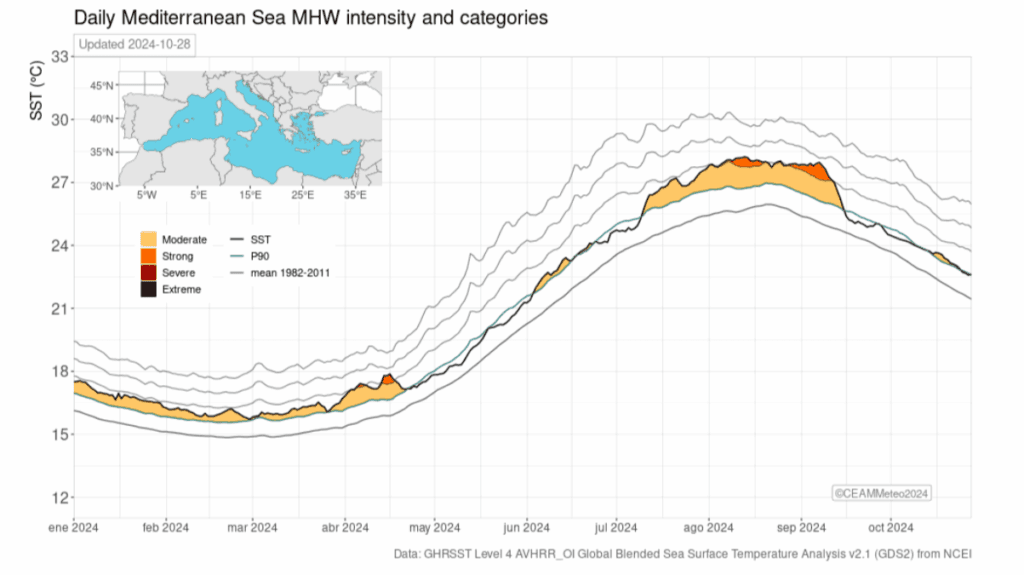
Daily evolution of marine heatwaves (MHW) in 2024 in the Mediterranean Sea
Marine heatwaves (MHWs) can be categorized based on their intensity. Hobday et al. (2018) proposed a naming convention for MHWs that establishes four categories based on the maximum observed intensity.
| Category | Description |
|---|---|
| I Moderate | Marine heat waves whose maximum intensity does not double the distance between seasonal climatology and the detection threshold value. |
| II Strong | Marine heat waves whose maximum intensity doubles the distance between the seasonal climatology and the detection threshold, but does not triple it. |
| III Severe | Marine heat waves whose maximum intensity triples the distance between the seasonal climatology and the detection threshold value. |
| IV Extreme | Marine heatwaves with a maximum intensity four times or greater than the distance between seasonal climatology and the detection threshold. These events are currently infrequent and highly localized. |