
About MHW
What are marine heat waves?
The Mediterranean Monitoring System (MEDMOS) is an initiative of the Meteorology and Climatology Area at the Mediterranean Center for Environmental Studies devoted to the surveillance and analysis of the Mediterranean Sea, mainly regarding sea surface temperature (SST) and its associated extreme event, marine heatwaves (MHW).
Oceans play a key role in energy storage in the global Earth–Ocean–Atmosphere system. Within this framework, the knowledge of past evolution and future SST trends is crucial for the understanding of future climate scenarios. Recent studies have highlighted the role of SST as an important ingredient for the development and/or intensification of heavy precipitation events (HPE) in the Mediterranean basin, and other areas in the world, but have also highlighted its role in heat waves in Europe. Hence, SST study and monitoring could play a role in the forecasting of HPE events.
MEDMOS aims to provide information, as up-to-date as possible, on the state of the Mediterranean that is useful to the scientific community, the general public and public policy makers in the context of climate change.
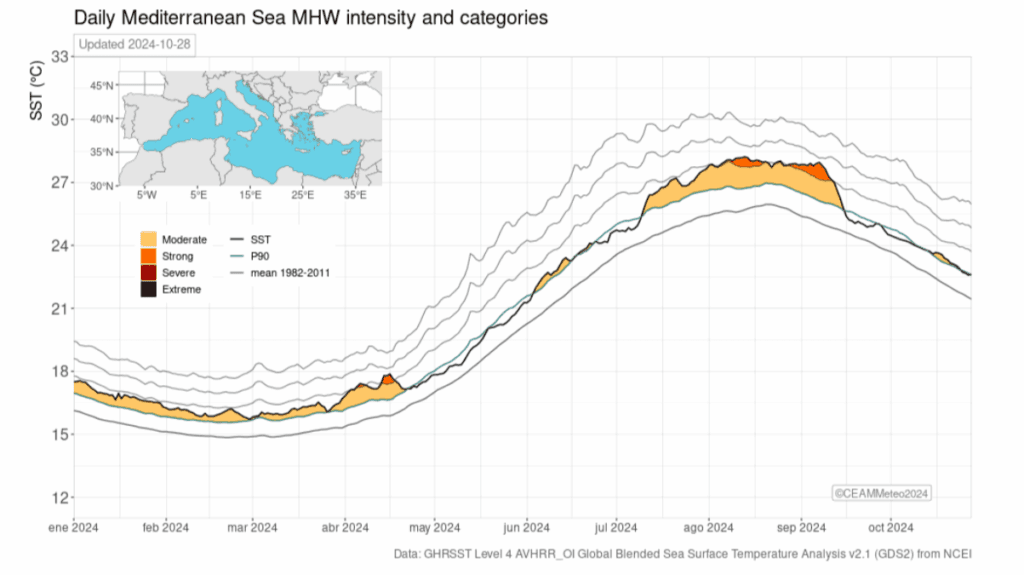
Daily evolution of marine heatwaves (MHW) in 2024 in the Mediterranean Sea
Marine heatwaves (MHWs) can be categorized based on their intensity. Hobday et al. (2018) proposed a naming convention for MHWs that establishes four categories based on the maximum observed intensity.
| Category | Description |
|---|---|
| I Moderate | Marine heat waves whose maximum intensity does not double the distance between seasonal climatology and the detection threshold value. |
| II Strong | Marine heat waves whose maximum intensity doubles the distance between the seasonal climatology and the detection threshold, but does not triple it. |
| III Severe | Marine heat waves whose maximum intensity triples the distance between the seasonal climatology and the detection threshold value. |
| IV Extreme | Marine heatwaves with a maximum intensity four times or greater than the distance between seasonal climatology and the detection threshold. These events are currently infrequent and highly localized. |