
About SST
About Sea Surface Temperature
Sea Surface Temperature (SST) is one of the Essential Climate Variables (ECVs) defined by the Global Climate Observing System (GCOS) to monitor and characterise the state of the global climate system. SST is an indicator of the heat flow in the air-sea interface and can be used to identify oceanic features such as fronts and upwelling areas. It is also an essential variable for ocean and weather prediction.
As SST warms, it influences weather and climate patterns from local to global scales. SST monitoring and long-term analysis is essential for assessing the impacts of climate change and predicting extreme weather events such as tropical cyclones or heavy precipitation events at a regional scale, like flash floods in the Mediterranean area. SST is also being used to forecast changes in the ocean at bigger scales, such as the El Niño Southern Oscillation.
In the global ocean, SST varies with latitude, with the colder values in the Arctic and Antartic regions and warmer water around the equator. This temperature gradient can be easily seen in the oceans, but it is not so clear in a marginal sea as the Mediterranean.
SST definition
There is not a single definition of SST as the upper ocean presents a variable temperature structure related to ocean turbulence and air-sea heat, momentum and moisture fluxes. Then, several definitions for SST are used for the different temperature values that can be measured at different depths in upper ocean layer. The figure shows the different definitions proposed by the Group for High Resolution Sea Surface Temperature (GHRSST, https://www.ghrsst.org/)
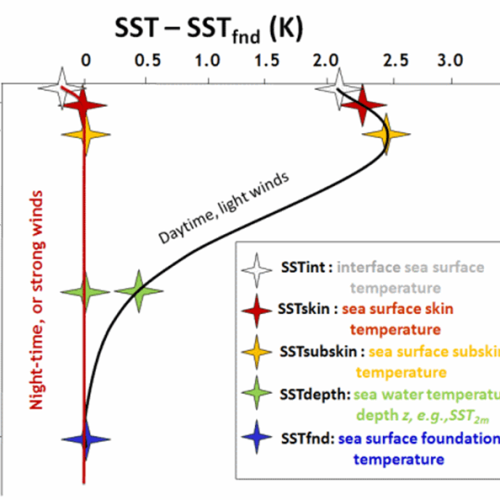
The definitions shown in the figure are:
Interface temperature (SSTint)
This corresponds to the exact air-sea interface layer. Yet, actually this is of no practical use since the temperature at this level cannot be measured using current technology.
Skin sea surface temperature (SSTskin)
This is the temperature measured by an infrared radiometer within the 3.7-12 μm wavelengths range. It corresponds to a layer of ~10-20 μm depth. SSTskin measurements are subject to a large potential diurnal cycle.
Sub-skin sea surface temperature (SSTsub-skin)
Corresponds to about 1 mm depth. For practical purposes, SSTsub-skin can be well approximated to the measurement of surface temperature by a microwave radiometer operating in the 6-11 GHz frequency range.
Sea temperature at depth (SSTz or SSTdepth)
All measurements of water temperature beneath the SSTsub-skin are referred to as depth temperatures (SSTdepth). Such temperatures may be obtained using a wide variety of platforms and sensors such as drifting buoys, vertical profiling floats, or deep thermistor chains at depths ranging from 10-2 to 103 m. These temperature observations are distinct from those obtained using remote sensing techniques (SSTskin and SSTsub-skin) and must be qualified by a measurement depth in meters.
Foundation temperature (SSTfnd)
For the depth where SSTfnd corresponds to there is no influence of the diurnal temperature variability. The SSTfnd (foundation temperature) can only be measured using in situ contact thermometers.
Additional information on SST from EumeTrain (https://resources.eumetrain.org/data/6/619/index.htm)